Normal Delivery vs C-Section — Which Is the Right Choice for You?
April 16, 2026 · 8 min read
Written & medically reviewed by Dr. Shaivalini Kamarapu
MBBS · MS (Obstetrics & Gynaecology) · Fellowship in Reproductive Medicine · 20+ years of clinical experience
A question almost every expecting mother asks
One of the most common questions expecting mothers in Hyderabad ask is: should I choose a normal delivery or a C-section? It is a question that brings a lot of anxiety, especially for first-time mothers. The good news is that there is no single right answer — it depends entirely on your health, your baby's health and your medical situation.
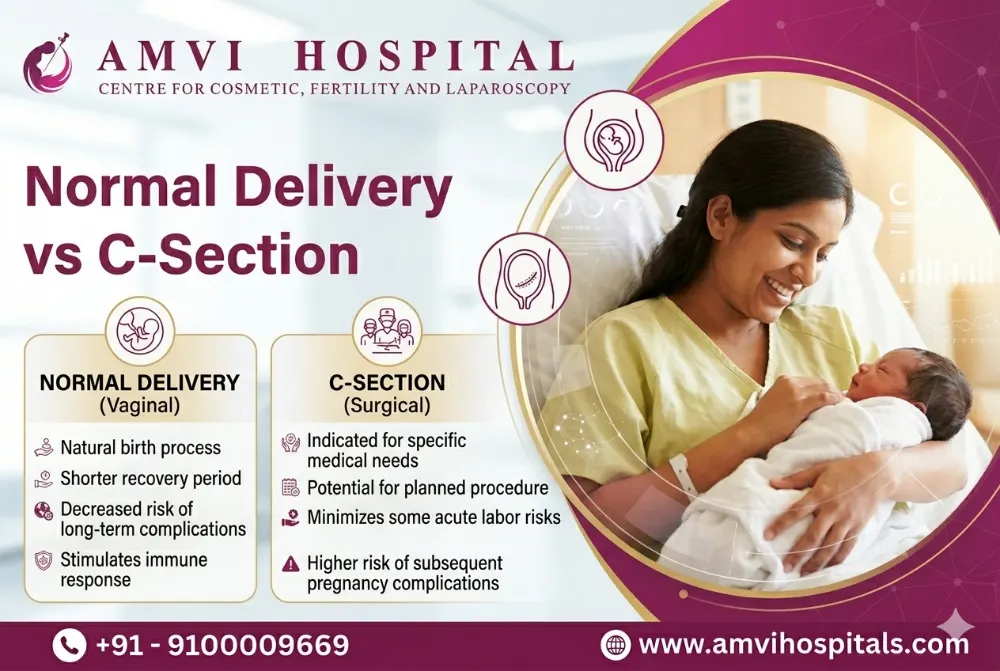
A normal delivery (vaginal birth) is the natural way babies are born. A C-section (caesarean section) is a surgical procedure in which the baby is delivered through an incision in the abdomen. Both are safe when performed by the right medical team in a well-equipped hospital.
Normal delivery vs C-section — a side-by-side comparison
Here is a clear comparison of the two delivery methods on the points that matter most to mothers.
- Recovery time — Normal delivery: 1–2 days in hospital and 2–4 weeks at home. C-section: 3–5 days in hospital and 6–8 weeks at home.
- Pain after delivery — Normal delivery: perineal soreness that is usually manageable. C-section: incision pain, controlled with medication.
- Infection risk — Normal delivery: lower. C-section: slightly higher, because of the surgical wound.
- Future pregnancies — Normal delivery: no restrictions. C-section: may limit the total number of C-sections advised.
- Breastfeeding — Normal delivery: usually starts naturally within hours. C-section: may take slightly longer to establish.
- Baby's breathing — Normal delivery: the birth canal helps squeeze fluid from the baby's lungs. C-section: a slightly higher chance of short-term breathing issues.
- Cost — Normal delivery: generally lower. C-section: higher, because of the surgical team and longer stay.
Everything about normal delivery
A normal delivery is the most natural way to bring a baby into the world. The baby moves through the birth canal with the help of uterine contractions. Most healthy pregnancies can result in a safe normal delivery with the right care and support.
Labour begins when your body produces hormones that trigger contractions. These contractions gradually open (dilate) the cervix. When the cervix is fully dilated to 10 cm, you push the baby out with each contraction while your doctor guides the baby out safely.
- Shorter recovery — most mothers feel normal within 2–3 weeks
- Lower risk of infection, since there is no surgical incision
- The baby gets a natural immunity boost from the birth canal
- Breastfeeding can begin within the first hour
- Shorter hospital stay — usually just 1–2 days
- No restrictions on future pregnancies
Who is a good candidate for normal delivery?
A normal delivery is usually possible when:
- It is a single pregnancy (one baby, not twins)
- The baby is positioned head-down (vertex position)
- There are no serious medical conditions such as preeclampsia
- The placenta is in a normal position (not placenta previa)
- There is no previous uterine surgery or complicated C-section
Everything about C-section
A caesarean section is a surgical procedure in which the obstetrician makes an incision through the abdomen and uterus to deliver the baby. It is one of the most commonly performed operations in the world and, when done for the right reasons, it can be life-saving.
A planned (elective) C-section is scheduled in advance, usually after 39 weeks, when a medical reason is identified during pregnancy. An emergency C-section is done urgently during labour when a problem arises that cannot be resolved with a normal delivery.
What to expect during a C-section
- You receive spinal or epidural anaesthesia — you stay awake but feel no pain
- A screen is placed so you do not see the incision
- The baby is delivered in about 5–10 minutes
- Closing the incision takes another 30–40 minutes
- Your partner can usually be present in the room
- You can hear your baby cry and see them immediately
Dr. Shaivalini's note on elective C-sections
"Many women choose C-sections out of fear of labour pain. While I fully understand this, I always encourage patients to try for a normal delivery first — with proper pain management such as epidural analgesia. The recovery is faster and your body heals more naturally. However, if a C-section is medically needed, rest assured that our team at AMVI performs it with the highest standards of care." — Dr. Shaivalini Kamarapu
When is a C-section medically necessary?
Not every C-section is elective. In many situations a C-section is the safest option for mother and baby, and your doctor will always discuss this with you clearly and honestly. Common medical reasons include:
- Breech or transverse position — the baby is not head-down by 36 weeks
- Placenta previa — the placenta is blocking the birth canal
- Multiple pregnancy — twins or triplets in certain positions
- Foetal distress — the baby's heart rate drops dangerously during labour
- Failure to progress — labour stalls and does not move forward
- A previous C-section with a uterine scar — risk of uterine rupture
- Preeclampsia or eclampsia — severe blood pressure complications
- A large baby (macrosomia) — too large to pass through the birth canal safely
- Cord prolapse — the umbilical cord comes out before the baby
Painless normal delivery — is it possible?
Yes. Painless normal delivery uses epidural analgesia — a local anaesthetic injected into the space around the spinal cord. It blocks pain signals from the lower body while you stay fully awake and can push when needed.
- You feel pressure but not pain during contractions
- You are fully alert and can take part in the birth
- It reduces stress and anxiety during labour
- It is safe for mother and baby when given by an experienced anaesthesiologist
- It is available at AMVI Hospitals — ask Dr. Shaivalini at your next appointment
Recovery tips for both types of delivery
Recovery is one of the biggest differences between the two methods. Knowing what to expect helps you plan, especially if you have other children at home.
- Rest as much as possible in the first 2 weeks
- Accept help from family — do not try to do everything alone
- Eat iron-rich and protein-rich foods to heal faster
- Keep the wound area (after a C-section) clean and dry
- Attend all postnatal follow-up appointments
How to decide what's right for you
The decision between a normal delivery and a C-section should always be made together — by you and your doctor. It should never be driven by fear, convenience or social pressure alone. Questions worth asking your doctor:
- Is my baby in the right position for a normal delivery?
- Do I have any medical condition that makes a C-section necessary?
- Is painless (epidural) delivery available at your hospital?
- How likely is it that I would need an emergency C-section?
- If I have had a C-section before, can I try for a VBAC (vaginal birth after caesarean)?
The safest delivery is the one that is right for your situation. If your pregnancy is progressing normally, a natural delivery with proper support — including pain relief such as an epidural — is almost always the first choice. If your doctor recommends a C-section for medical reasons, it is a safe, well-established procedure.
At AMVI Hospitals, Dr. Shaivalini Kamarapu and our maternity team guide every mother through this decision with honesty, care and up-to-date medical knowledge.
Frequently asked questions
In some cases an elective C-section is possible if you have a medical or psychological reason. However, Dr. Shaivalini will first discuss the real risks and benefits with you. A C-section is major surgery with a longer recovery, so it is usually better to try for a natural delivery if your health allows it.
During labour, contractions can be very intense — but with epidural analgesia (painless delivery) the pain is greatly reduced. After delivery, recovering from a normal delivery is usually much less painful than recovering from a C-section, which involves surgical wound pain for several weeks.
VBAC stands for vaginal birth after caesarean. It is possible for many women, and a majority of women who attempt a VBAC are successful. It depends on the reason for your previous C-section and the type of uterine incision. Dr. Shaivalini can assess whether a VBAC is safe for you.
A previous C-section does not prevent future pregnancies. However, scar tissue from a C-section can sometimes complicate later pregnancies. After two or more C-sections, your doctor may recommend spacing pregnancies carefully, and regular prenatal monitoring is important.
For a normal, uncomplicated pregnancy, yes. Babies born vaginally are exposed to beneficial bacteria in the birth canal, and their lungs are naturally prepared for breathing as the birth canal squeezes out fluid. Babies born by C-section sometimes need short-term breathing support, though this is usually minor and temporary.
The baby is usually delivered within 5–10 minutes of the surgery starting. Closing the incision takes another 30–45 minutes, so the total time in the operation theatre is usually about 45–60 minutes. The hospital stay is typically 3–5 days.
Yes. AMVI Hospitals offers epidural analgesia for normal delivery, given by experienced anaesthesiologists. You stay awake and take part in the birth with significantly less pain. Ask about this option at your next antenatal visit.
Have questions about this?
Talk it through with our team at Puppalaguda or Attapur.