
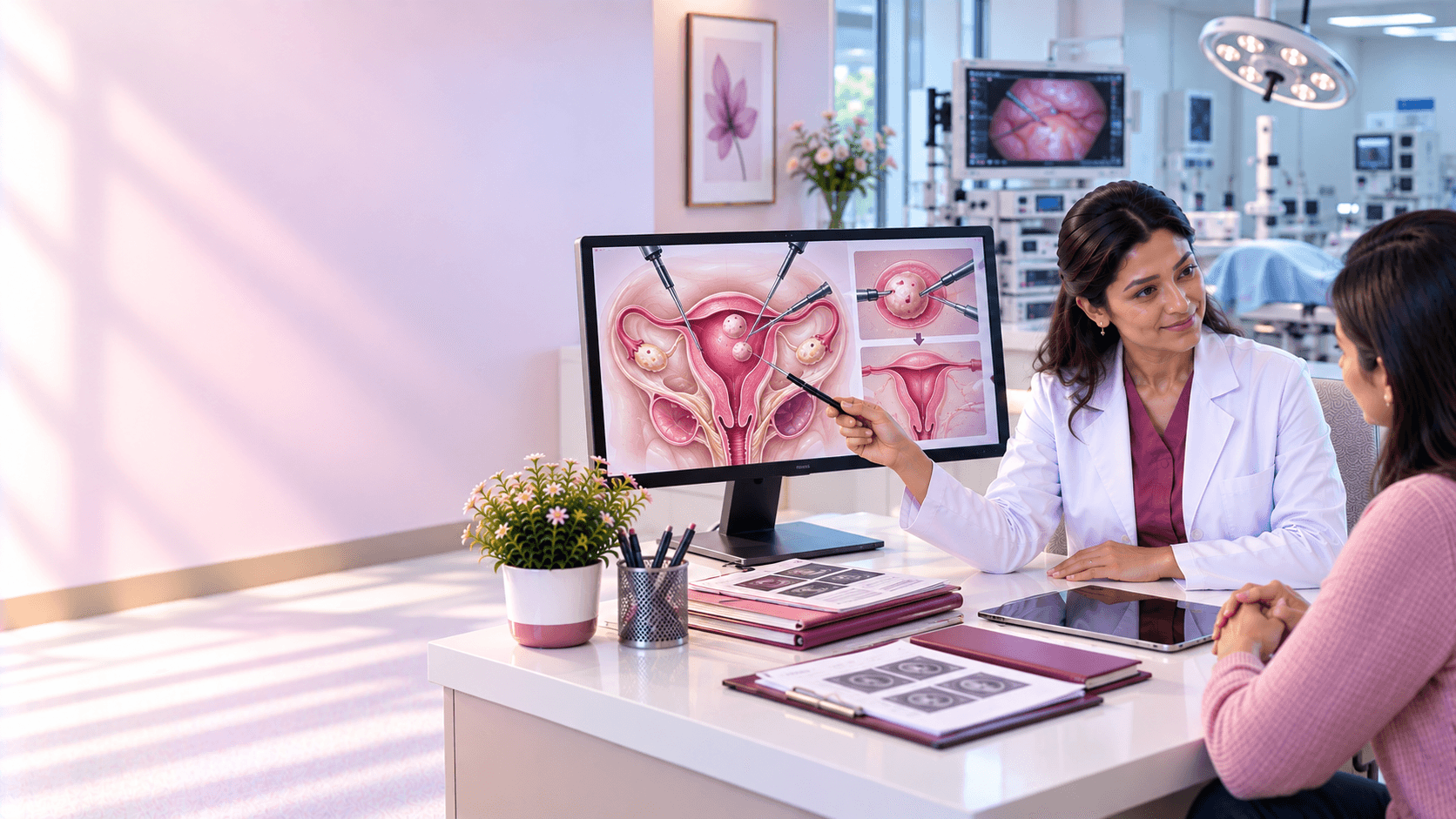
Laparoscopic Myomectomy in Hyderabad
Laparoscopic Surgery
Written & medically reviewed by Dr. Shaivalini Kamarapu
MBBS · MS (Obstetrics & Gynaecology) · Fellowship in Reproductive Medicine · 20+ years of clinical experience
20+
Years of Experience
2
Branches in Hyderabad
24/7
Care at both branches
What is laparoscopic myomectomy?
Laparoscopic myomectomy is a minimally invasive surgery to remove fibroids — non-cancerous growths that can cause heavy periods, pelvic pain, infertility, or a feeling of pressure in the lower abdomen — while leaving the uterus intact.
Small incisions are made in the abdomen, and a thin camera (laparoscope) is used to see inside while special instruments remove the fibroids safely. Compared to open surgery, it means less pain, smaller scars, and a faster recovery, and it's often the preferred option for women who want to preserve fertility and plan a future pregnancy.
When is myomectomy recommended?
Pre-surgical testing
Ultrasound scan
A pelvic ultrasound identifies the size, number, and location of fibroids — the first and most important diagnostic test.
Blood tests
Checks haemoglobin levels for anaemia, blood group, sugar levels, thyroid function, and overall health.
MRI (if required)
Used in more complex cases to get a detailed view of fibroid position and uterine structure.
Hormonal evaluation
Hormone levels may be checked if irregular periods or fertility concerns are present.
Pre-anaesthesia checkup
A complete fitness evaluation confirms the patient is ready for surgery.
Why choose laparoscopic myomectomy?
Step-by-step procedure
Pre-surgical evaluation & planning
Pelvic ultrasound, blood tests, and sometimes MRI map the exact size, number, and location of fibroids ahead of surgery.
Pre-anaesthesia assessment
A complete medical fitness check reduces surgical risk before the procedure begins.
General anaesthesia
The patient remains asleep and pain-free throughout the surgery.
Small incisions
Three to four small incisions (usually 0.5–1 cm) are made in the abdomen.
Laparoscope insertion
A high-definition camera is inserted through one incision, giving a clear, magnified view of the uterus and fibroids.
Fibroid identification & removal
Fibroids are carefully separated from the uterine wall using specialised instruments, preserving healthy tissue — even multiple fibroids can be removed safely.
Uterine reconstruction
The uterine muscle is stitched layer by layer to restore strength and structure, which matters especially for future pregnancy.
Closure of incisions
Small incisions are closed with minimal sutures or skin glue, leaving very small scars.
Recovery after surgery
Hospital stay
1–2 days of observation is usually sufficient.
Pain management
Mild pain is managed with prescribed medication.
Early walking
Patients are encouraged to walk within 24 hours.
Return to work
Light activities can typically resume within 7–10 days.
Improved menstrual symptoms
Bleeding and pain usually reduce significantly afterward.
Pregnancy planning
Doctors generally advise waiting 3–6 months before planning a pregnancy.
Laparoscopic myomectomy is generally safe when performed by experienced surgeons. Minor risks like infection, bleeding, or an anaesthesia reaction can occur but are uncommon. In rare cases — where fibroids are extremely large or numerous — conversion to open surgery may become necessary; thorough pre-surgical evaluation helps minimise that likelihood.
Who is a good candidate for laparoscopic myomectomy?
Laparoscopic myomectomy suits women whose fibroids are causing problems and who want to keep their uterus. That includes heavy bleeding that disrupts daily life or causes anaemia, pelvic pain or a feeling of pressure, and a visibly enlarged abdomen from large fibroids.
It is also advised when fibroids distort the inside of the uterus and may stop an embryo from implanting, when fibroids are linked to repeated miscarriages, and when medicines have not shrunk the fibroids or controlled the symptoms. Because the uterus is preserved and recovery is quicker than with open surgery, it is often the preferred option for women planning a pregnancy.